One interesting side effect of the rising adoption of AI tools is a growing sense of suspicion that any type of digital content we consume may have been created by AI. Whenever people now encounter an em dash – once an innocent punctation mark – the “this is AI” alarm bells go off. After all, the “ChatGPT hyphen” is widely known as one of several tells that a text may have been written by AI. However, the em dash alone doesn’t prove AI authorship. It’s been around for much longer than ChatGPT and many writers continue to use it. When combined with other AI writing tropes, it can be a sign of likely AI involvement though.
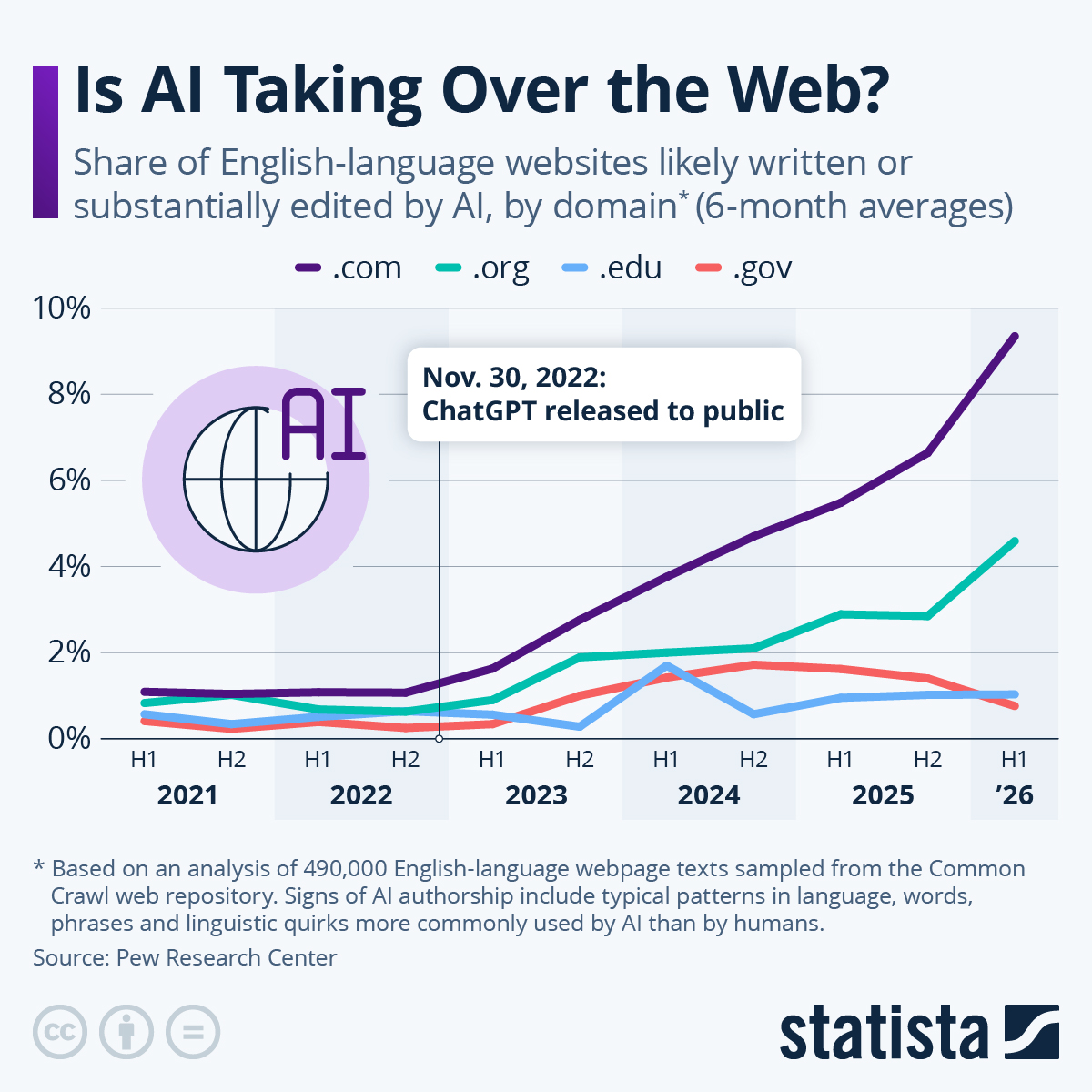
To find out how much online content is actually written by AI, Pew Research Center ran almost half a million webpages archived by nonprofit Common Crawl through an AI detection tool called Open Pangram, which uses machine learning to determine whether a text was likely written by AI. The result shows a notable increase in content likely authored by AI since the release of ChatGPT in November 2022. While just 1 percent of webpages under .com domains showed significant signs of AI authorship prior to that date – a sign that no AI detection tool is perfect by the way – that share has risen to more than 9 percent in the first half of 2026. While that may not sound like a lot, it needs to be noted that the sample includes pages published before ChatGPT, meaning that the percentage of AI-generated text is likely much higher for more recent content.
After filtering for websites published after the release of ChatGPT, Pew found that 35 percent of the webpages it sampled in July 2026 showed a high likelihood of AI authorship or editing, versus just 9.6 percent of all websites in the July 2026 snapshot. That goes to show how quickly AI-generated content is taking over the web and that the suspicions regarding online text are not unfounded. Interestingly, the use of AI appears to be significantly lower still for websites with .gov or .edu domains, meaning that government agencies and educational institutions still rely on human authorship to a larger degree.