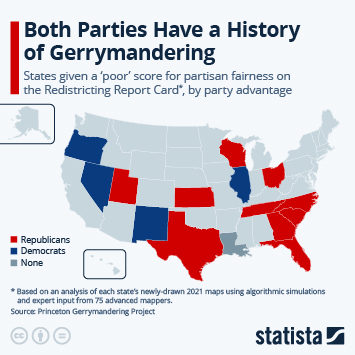
The ongoing election cycle brought about an highly unusual bout of voluntary redistricting in the United States. It started with a Trump-encouraged redistricting in Texas, followed by other red states and a push-back from California, which has remained the only blue state to successfully change its Congressional map so far.
A Statista analysis shows that in terms of voluntary redistricting, Republicans are expected to draw a bigger advantage from their gerrymandering efforts than Democrats. Also taking into account changes to Congressional maps made between the 2024 and 2026 elections that were required by law or litigation, Republicans still remain the redistricting winners.
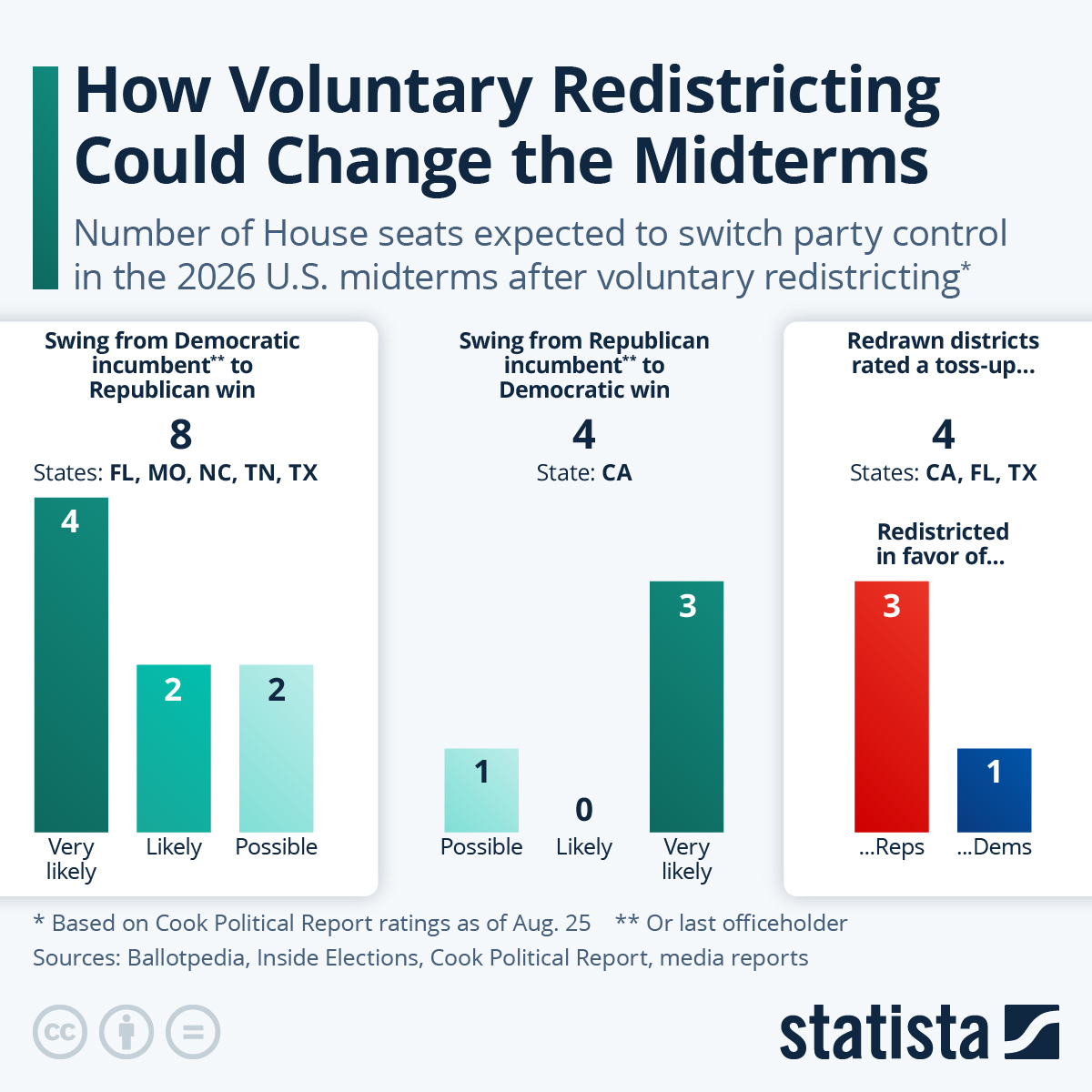
Out of the 12 districts in Texas, Florida, North Carolina, Missouri and Tennessee that have been identified as changing shape in order to flip their seats from Democrats to Republicans in 2026, eight are rated by the Cook Political report as having a Republican edge. Three were altered weakening Democrats, but remain a toss-up in the lead-up to November, while one weakened district - TX-28 – is holding on to a slight Democratic lead as incumbent Henry Cuellar says Democrats' efforts to win back Latino voters can be successful this year.
All 12 districts have Democratic incumbents or were last led my Democrats, but were carried by Trump in the 2024 presidential election, making them targets for Republican redistricting campaigns.
After Gov. Gavin Newsom's reacted to Texas' unusual redistricting with a post on X saying: "Two can play that game", the state moved to redistrict as well. Five districts were changed with the intention to switch party control to Democrats, out of which four were most recently rated as having a Democratic edge, while one was rated a toss-up. One more district, CA-13, that Democrats strengthened for themselves and that has a Democratic incumbent is still in a fairly competitive race, however, seeing incumbent Adam Gray moving to the center in order to appeal to rural Californians and even voted with Republicans to end the most recent government shutdown.
Talking into account recent redistricting due to litigation – affecting Alabama, Louisiana and Utah – and regular redistricting required by law – affecting Ohio –, Democrats are expected to flip one seat, while Republicans are expected to gain two and look forward to two more tight races in Ohio as Reps. Greg Landsman's and Marcy Kaptur's districts became more competitive. Again, both of these districts voted for Trump in the presidential election of 2024, promting Republican redistriction action.