Cotton - statistics & facts
China, India, and Brazil are the largest producers of cotton, responsible for more than half of the world's total production volume. The total global supply of cotton, stocks included, amounted to roughly 235 million metric tons as of 2024/25. The crop is the most often used natural fiber worldwide, and thus an important component of the textile industry. In 2024/2025, the total global production of cotton amounted to some 119 million bales.
Brazil's rise as a cotton powerhouse
The top exporter of cotton was Brazil, with roughly 3.2 million metric tons of cotton exported around the world in 2025/2026. Other leading exporters were the U.S. and Australia. The U.S. exported the majority of its harvested cotton for processing abroad. Among the leading importers were Bangladesh, Vietnam, and China, all of which are well-known for their production of large quantities of cotton clothing.
Why the biggest growers barely export
China and India dominate cotton production by a wide margin, together accounting for nearly half of all cotton grown worldwide. Yet when it comes to exports, neither country ranks among the top three. Both countries have enormous textile and apparel manufacturing sectors that consume the vast majority of their cotton harvests domestically. China is the world's largest textile producer, and India is not far behind. This creates a two-tier structure in the global cotton market. Producer-exporters like Brazil, the United States, and Australia grow cotton largely for the world market, while producer-consumers like China, India, and Pakistan use their harvests to feed domestic manufacturing.
A decade of volatility, then a cooldown
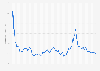
Prices for cotton remained relatively stable between 2003 and 2009, roughly ranging between 55 and 71 U.S. cents per pound on the global market. Record highs were reached in 2011, when the global average price climbed to roughly 155 cents per pound. 2012 was marked by a heavy price decline. Between 2012 and 2022, cotton prices increased but at a slower pace. By 2025, the global average had dropped to roughly 77 cents per pound, the lowest level since 2016. In the U.S. market, a cotton farmer received an average price of 62 cents per one pound of upland cotton as of 2025. Falling prices, combined with steady production volumes, suggest that global supply has been keeping pace with demand in recent years.